


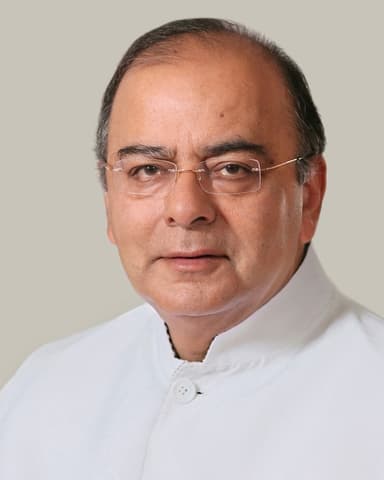
In history
Arun Jaitley
1952–2019
Finance Minister 2014–19: pushed GST through the Council and wrote the Insolvency and Bankruptcy Code. Jailed nineteen months in the Emergency for burning Indira Gandhi's effigy, he later defended Aadhaar in court, and his last public words praised Article 370's abrogation as 'monumental'.
Furthest from the middle on Markets, toward Market-led development.
Where they stand
Arun Jaitley on each of the seven scales, from one pole to the other.
Welfare
+3.0Expansive state provisionMinimal/targeted provisionMarkets
+6.0State-led developmentMarket-led developmentRecognition
−1.0Formal equalityGroup remediesNation
+5.0PluralistMajoritarianAuthority
+2.0Civil libertiesStrong stateCulture
0.0Personal autonomyTraditional normsFederalism
−4.0CentreStates
The record, axis by axis
Every placement is scored on what was said and done — manifestos, legislation, the governing record — and calibrated against the same trade-offs the quiz asks about.
Jan Dhan Yojana built financial-inclusion infrastructure — enabling access rather than expanding direct entitlement — inside a ministry otherwise focused on fiscal consolidation
Chief negotiator of GST (rolled out 1 July 2017 after a decade of stalled consensus, commentators crediting his handling of opposition-ruled states), architect of the Insolvency and Bankruptcy Code for the bad-loans crisis, and the government's lead public defender of 2016 demonetisation — structural, institutional reform comparable in weight to Vajpayee's market-orientation record but not exceeding it: Vajpayee's government actually sold VSNL, BALCO, Hindustan Zinc and Maruti, where Jaitley's own signature disinvestment push, Air India in 2018, found no buyer during his tenure and closed without a sale
No personal quota-expansion or quota-opposition record distinct from BJP's institutional line (EWS 10%, existing quotas kept, no caste census); read here off the party line he administered rather than an act of his own
Wrote his final public blog on 6 August 2019, days before his death, calling the Article 370 abrogation 'a monumental decision towards National integration' — a direct, on-record, near-terminal endorsement, not an inferred position
Arrested 26 June 1975, the morning after the Emergency, for burning an effigy of Indira Gandhi as an ABVP/DUSU leader, and held nineteen months under preventive detention in Tihar — against, decades later, his role as the government's chief defender of the 2018 Supreme Court Aadhaar verdict, framing privacy as 'a fundamental right but not an absolute right' and citing ₹900 billion a year saved by eliminating fake beneficiaries
No record; not his portfolio
GST required extensive Centre-state bargaining through the Council he chaired, a genuinely consultative process — but its structural effect was states ceding independent tax-setting power for a share of a centrally pooled and administered levy, the same centralising mechanism cited in this roster's own placement of Narendra Modi
And where do you stand?
Answer the same trade-offs yourself and get your seven readings, on the scales you just read.
Free · Anonymous · No account