


In history
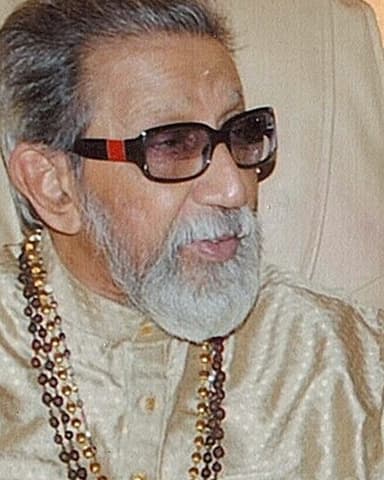
Bal Thackeray
1926–2012
Shiv Sena's founder, 1966, who never held office and never needed to — chief ministers answered to him by phone. Built a career on 'sons of the soil' hiring and, later, open Hindutva; the Srikrishna Commission named him a director of the 1992–93 Bombay riots.
Furthest from the middle on Nation, toward Majoritarian.
Where they stand
Bal Thackeray on each of the seven scales, from one pole to the other.
Welfare
−1.0Expansive state provisionMinimal/targeted provisionMarkets
−1.0State-led developmentMarket-led developmentRecognition
−4.0Formal equalityGroup remediesNation
+9.5PluralistMajoritarianAuthority
+8.0Civil libertiesStrong stateCulture
+6.0Personal autonomyTraditional normsFederalism
+3.0CentreStates
The record, axis by axis
Every placement is scored on what was said and done — manifestos, legislation, the governing record — and calibrated against the same trade-offs the quiz asks about.
No redistributive welfare programme; Shiv Sena's economic politics were about protecting jobs for a regional-ethnic group, not expanding or shrinking state provision as such
No developed ownership or planning position beyond the same ethnic-hiring-preference politics
When V.P. Singh's government announced implementation of the Mandal Commission's OBC quotas in August 1990, Thackeray personally and publicly opposed it, arguing that Shiv Sena 'did not believe in caste' and that only Marathi-manoos identity and Hindutva mattered — a stance serious enough that Shiv Sena's own OBC leader, Chhagan Bhujbal, broke away over it, warning it would cost the party its 60–70% OBC vote base, and BJP's separate decision to back Mandal implementation nearly ended the Sena-BJP alliance. This is the one clearly on-axis, personal, consequential position he took on caste-quota expansion, and it points toward formal equality, not group remedy. Shiv Sena's founding 1966 demand that Mumbai employers prioritise hiring Marathi 'sons of the soil' over migrant workers is a related but different phenomenon — a linguistic-regional group-remedy claim, not the caste or religious-minority frame this axis's item bank actually centres on — and should not be read as pointing the other way
Shifted from Marathi ethnic nativism (1960s–80s) to open Hindutva and Ram Janmabhoomi support in the 1990s. On record, in a mid-1990s Asiaweek interview: 'I am a great admirer of Hitler... he was a wonderful organiser and orator, and I feel that he and I have several things in common.' Told Time in a 25 January 1993 interview that if Indian Muslims had 'behaved like the Jews in Nazi Germany', there was 'nothing wrong' in treating them 'as Jews were in Germany' — a conditional answer to a direct question rather than an unprompted declaration, but no less extreme for that. The Srikrishna Commission's 1998 report (502 witnesses, 2,903 exhibits) found that from 8 January 1993, Thackeray, 'like a veteran General', commanded his Shiv Sainiks to retaliate with organised attacks on Muslims, and indicted him for incitement
Never held elected or appointed office, yet exercised de facto control over Mumbai and Maharashtra governance through Shiv Sena's street power — chief ministers such as Manohar Joshi (1995–99) were widely understood to answer to him personally, and the Srikrishna Commission found police reluctant to arrest him during the 1992–93 riots given his power — a coercive, strongman concentration of authority exercised extra-constitutionally rather than through formal state office
Comfortable with traditional gender and family norms, no reform record; Shiv Sena cadres were also well documented for vigilante moral-policing (disrupting Valentine's Day events, film and book releases) in the name of cultural protection
'Sons of the soil' politics is a regional-identity assertion against migrants from other Indian states rather than a constitutional claim for greater state autonomy from Delhi; Shiv Sena generally allied with BJP-led central coalitions and did not campaign for asymmetric federalism or special status, so this reads as regional identity politics rather than a states'-rights programme, at moderate strength
And where do you stand?
Answer the same trade-offs yourself and get your seven readings, on the scales you just read.
Free · Anonymous · No account