


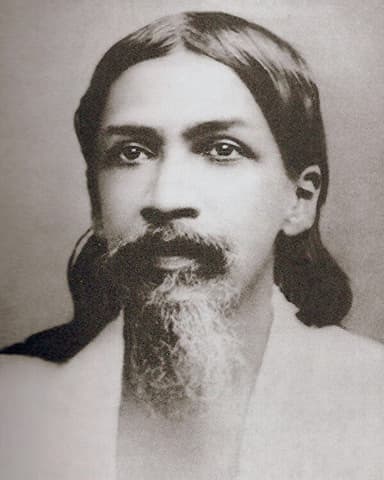
In history
Aurobindo Ghose
1872–1950
Bande Mataram's editor and the Extremists' theorist, until the Alipore Bomb Case and his withdrawal to Pondicherry in 1910. 'The Doctrine of Passive Resistance' (1907) supplied the boycott its strategy; the Uttarpara Speech of 1909 — 'the Sanatan Dharma, that is nationalism' — supplied the Hindu-spiritual nationalism others built on.
Furthest from the middle on Nation, toward Majoritarian.
Where they stand
Aurobindo Ghose on each of the seven scales, from one pole to the other.
Welfare
−1.0Expansive state provisionMinimal/targeted provisionMarkets
0.0State-led developmentMarket-led developmentRecognition
−5.0Formal equalityGroup remediesNation
+6.0PluralistMajoritarianAuthority
−4.0Civil libertiesStrong stateCulture
−1.0Personal autonomyTraditional normsFederalism
+2.0CentreStates
The record, axis by axis
Every placement is scored on what was said and done — manifestos, legislation, the governing record — and calibrated against the same trade-offs the quiz asks about.
The Human Cycle (serialised in Arya, 1916-18) reads the 'objective' state that provides for all as a genuine advance in one direction and a mechanising subjection of the individual in another; his own politics was about power, not provision
Swadeshi and boycott were weapons of the 1906-08 programme rather than an economic doctrine, and he later warned that socialism's logical end was the totalitarian state — leaving him with no position on ownership at all
'The Unhindu Spirit of Caste Rigidity' and 'Caste and Democracy' (Bande Mataram, 1907) call hereditary caste a corruption to be dissolved into a democratic distribution of function — abolition by dissolution, with nothing said for or against specific protections
The Uttarpara Speech of 30 May 1909 — 'It is the Sanatan Dharma which for us is nationalism' — and the Bhawani Mandir pamphlet's nation-as-goddess, against his 15 August 1947 message calling Partition 'a temporary expedient' that must go and asking for Hindu-Muslim unity
'The Doctrine of Passive Resistance' (April 1907) makes it a duty to break an unjust law and take the legal consequence; he was prosecuted for sedition over Bande Mataram and spent a year in Alipore jail before his 1909 acquittal — though the same text refuses to make non-violence absolute
The Human Cycle argues for a subjective age in which the individual finds the law within rather than in convention; his Pondicherry ashram kept no caste rules and was led by a European woman — set against its celibacy discipline and Sanatan Dharma as the ground of everything
The Ideal of Human Unity (Arya, 1915-18) and the 1947 message argue for free federation over coercive unity, from a united India up to a world union — the Centre-state question as now argued is simply not one he addressed
And where do you stand?
Answer the same trade-offs yourself and get your seven readings, on the scales you just read.
Free · Anonymous · No account