


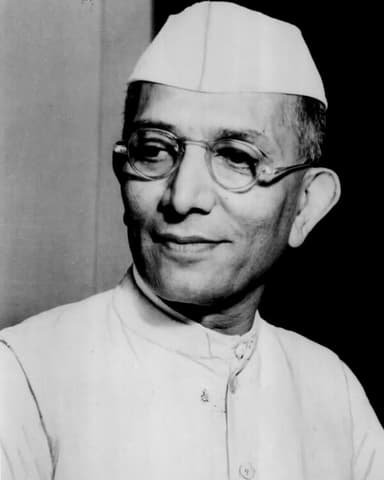
In history
Morarji Desai
1896–1995
Prime Minister 1977–79, and the first non-Congress one. His government dismantled the Emergency's legal architecture through the 44th Amendment and the Shah Commission; a Gandhian puritan on drink and personal conduct, and the fiscal conservative who lost the Finance portfolio to Indira Gandhi over bank nationalisation.
Furthest from the middle on Authority, toward Civil liberties.
Where they stand
Morarji Desai on each of the seven scales, from one pole to the other.
Welfare
+1.0Expansive state provisionMinimal/targeted provisionMarkets
0.0State-led developmentMarket-led developmentRecognition
+1.0Formal equalityGroup remediesNation
+1.0PluralistMajoritarianAuthority
−9.0Civil libertiesStrong stateCulture
+6.0Personal autonomyTraditional normsFederalism
−6.0CentreStates
The record, axis by axis
Every placement is scored on what was said and done — manifestos, legislation, the governing record — and calibrated against the same trade-offs the quiz asks about.
India's most orthodox Finance Minister — against deficit financing, against subsidy expansion, and openly contemptuous of populist provision — though the Janata government he led launched the Food for Work programme in 1977
Opposed bank nationalisation in 1969 and led the Congress right against Indira's socialism — while presiding over the Industrial Policy Statement 1977 reserving hundreds of items for small-scale industry and the FERA squeeze that pushed IBM and Coca-Cola out
His government appointed the Mandal Commission on 1 January 1979, the single act from which all later quota expansion flows — but it was the socialist bloc's price for the coalition, not his own programme, and he built nothing on it
A Gandhian secularist by conviction who nonetheless gave the Jana Sangh-RSS bloc its first Union office and let the dual-membership question run for two years until it broke the Janata Party in 1979
Nineteen months in solitary detention himself, then the 44th Amendment 1978 replacing 'internal disturbance' with 'armed rebellion', making Articles 20 and 21 unsuspendable and requiring written Cabinet advice; MISA repealed, the Press Council restored, the Shah Commission set up
Pushed prohibition as national policy in 1978 after enforcing it in Gujarat, held brahmacharya and dietary austerity as public standards he pressed on colleagues, and told an American television audience that he drank his own urine
On 30 April 1977 his government dismissed nine Congress state assemblies at one stroke under Article 356 on the ground that they had lost the people's mandate — the precedent Indira Gandhi turned around on the Janata states in 1980
And where do you stand?
Answer the same trade-offs yourself and get your seven readings, on the scales you just read.
Free · Anonymous · No account