


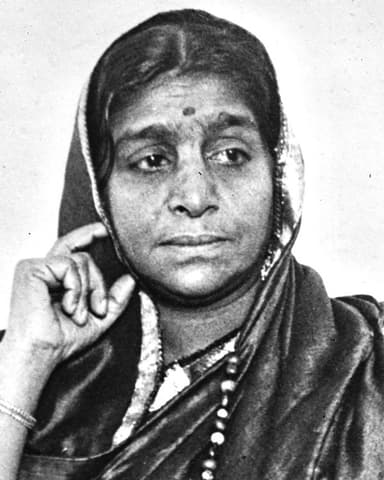
In history
Sarojini Naidu
1879–1949
Poet, first Indian woman to head Congress (1925), and first woman to govern an Indian state as United Provinces Governor (1947–49). Led the Dharasana salt raid after Gandhi's 1930 arrest, and campaigned throughout against child marriage, purdah and for Hindu-Muslim unity.
Furthest from the middle on Nation, toward Pluralist.
Where they stand
Sarojini Naidu on each of the seven scales, from one pole to the other.
Welfare
0.0Expansive state provisionMinimal/targeted provisionMarkets
0.0State-led developmentMarket-led developmentRecognition
+1.0Formal equalityGroup remediesNation
−6.0PluralistMajoritarianAuthority
−5.0Civil libertiesStrong stateCulture
−6.0Personal autonomyTraditional normsFederalism
−1.0CentreStates
The record, axis by axis
Every placement is scored on what was said and done — manifestos, legislation, the governing record — and calibrated against the same trade-offs the quiz asks about.
No developed position on state provision; her campaigning ran on suffrage, communal unity and civil disobedience rather than economic policy
No record found
Helped broker the 1916 Lucknow Pact, in which Congress accepted the Muslim League's demand for separate communal electorates — a group-remedy position for a religious minority, not the formal-equality one Congress later adopted after the Poona Pact reversed course in 1932 — but she also co-founded the Women's Indian Association (1917, with Annie Besant and Muthulakshmi Reddy) and campaigned for female suffrage as an extension of equal citizenship; the two data points pull in opposite directions and neither is really the caste/religion group-remedy the item bank centres on, so this nets close to neutral
Naidu herself called Jinnah the 'Ambassador of Hindu-Muslim Unity' in a 1917 biographical sketch (published 1918) honouring his role brokering the 1916 Lucknow Pact — a lifelong commitment to communal cooperation that the epithet she coined for him reflects onto her own politics just as much as his
After Gandhi's arrest during the Salt Satyagraha, she led roughly 2,500 marchers on the Dharasana Salt Works on 21 May 1930, was arrested for it, and was jailed repeatedly through the independence movement
Campaigned explicitly against child marriage, purdah seclusion, bigamy and sati as a women's-rights organiser — a sustained personal-autonomy programme aimed at reforming family and gender norms from within
No developed record; served as Governor of a unified United Provinces (15 August 1947 – 2 March 1949) inside the new Republic's constitutional structure rather than campaigning on Centre-state power
And where do you stand?
Answer the same trade-offs yourself and get your seven readings, on the scales you just read.
Free · Anonymous · No account