


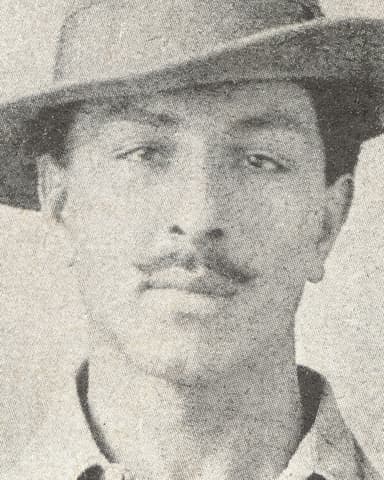
In history
Bhagat Singh
1907–1931
Revolutionary executed at 23. The assembly bomb as 'a voice to the deaf', prison hunger strikes, and the essays — 'Why I Am an Atheist' — that made him the socialist, rationalist icon both flanks now claim.
Furthest from the middle on Nation, toward Pluralist.
Where they stand
Bhagat Singh on each of the seven scales, from one pole to the other.
Welfare
−8.0Expansive state provisionMinimal/targeted provisionMarkets
−8.0State-led developmentMarket-led developmentRecognition
+5.0Formal equalityGroup remediesNation
−9.0PluralistMajoritarianAuthority
−1.0Civil libertiesStrong stateCulture
−6.0Personal autonomyTraditional normsFederalism
0.0CentreStates
The record, axis by axis
Every placement is scored on what was said and done — manifestos, legislation, the governing record — and calibrated against the same trade-offs the quiz asks about.
The HSRA manifesto and 'To Young Political Workers' call for a workers' and peasants' state as the point of independence
An avowed revolutionary socialist citing Marx and Lenin, wanting the means of production socialised
'Achhut ka Sawal' (1928) told untouchables to organise separately and claim representation rather than wait for reform from above
'Why I Am an Atheist' and 'Communal Riots and their Solution' (1928), which blamed religious leaders and the press by name
Threw a bomb in the Assembly and shot Saunders — but the socialism he argued for implies a strong revolutionary state, and this axis's issue space is entirely later
Atheist and anti-caste, hostile to religious orthodoxy, though he left almost nothing on gender, family or sexual autonomy
The HSRA envisaged a unitary socialist republic; he wrote nothing on Centre-state power as we now argue it
And where do you stand?
Answer the same trade-offs yourself and get your seven readings, on the scales you just read.
Free · Anonymous · No account