


In history
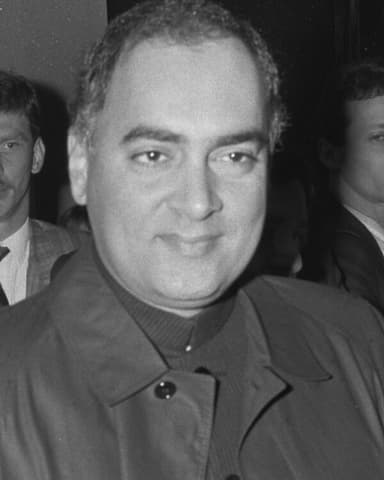
Rajiv Gandhi
1944–1991
Prime Minister 1984–89, elected on the largest majority in Indian history. Computers, telecom and the first cracks in the licence raj on one ledger; the Shah Bano reversal, the Babri Masjid locks and TADA on the other — and 1984 itself, answered with the line about the earth shaking when a big tree falls.
Furthest from the middle on Authority, toward Strong state.
Where they stand
Rajiv Gandhi on each of the seven scales, from one pole to the other.
Welfare
−5.0Expansive state provisionMinimal/targeted provisionMarkets
+2.0State-led developmentMarket-led developmentRecognition
−2.0Formal equalityGroup remediesNation
+2.5PluralistMajoritarianAuthority
+7.0Civil libertiesStrong stateCulture
+4.0Personal autonomyTraditional normsFederalism
−6.0CentreStates
The record, axis by axis
Every placement is scored on what was said and done — manifestos, legislation, the governing record — and calibrated against the same trade-offs the quiz asks about.
Jawahar Rozgar Yojana 1989, the National Literacy Mission 1988, Navodaya Vidyalayas 1986 and Operation Blackboard 1987 — expansion delivered through a state he himself said leaked 85 paise in every rupee
Delicensed dozens of industries, raised the MRTP asset threshold, cut the top income-tax rate and opened computers and telecom through the 1984 computer policy, C-DOT and MTNL — all inside the licence system, and stalled after Bofors and the 1987 payments strain
Opposed V.P. Singh's Mandal implementation from the opposition benches in 1990 and had shown no interest in quota expansion in office — while the 1986 Muslim Women Act is the period's most far-reaching protection of a minority's own personal law
The Babri Masjid locks opened in February 1986 with his government's acquiescence, the 1989 shilanyas permitted and the campaign launched from Faizabad on a 'Ram Rajya' promise, and 'when a big tree falls, the earth shakes' on 19 November 1984 — set against the Punjab, Assam and Mizoram accords
TADA in 1985 and its 1987 re-enactment, under which tens of thousands were detained for barely a 1% conviction rate; the Defamation Bill rammed through the Lok Sabha in 1988 and withdrawn after a press revolt; the 59th Amendment restoring 'internal disturbance' as an Emergency ground for Punjab
The Muslim Women (Protection of Rights on Divorce) Act 1986 overturned a Supreme Court maintenance award to a divorced woman at clerical demand — the period's clearest subordination of individual autonomy to religious personal law, against a National Education Policy 1986 with a serious women's-education commitment
Dismissed the Bommai government in Karnataka in April 1989 and extended President's Rule in Punjab to three years by amendment; the 64th Amendment panchayati raj bill of 1989 devolved past the states rather than to them, and the Rajya Sabha blocked it
And where do you stand?
Answer the same trade-offs yourself and get your seven readings, on the scales you just read.
Free · Anonymous · No account